
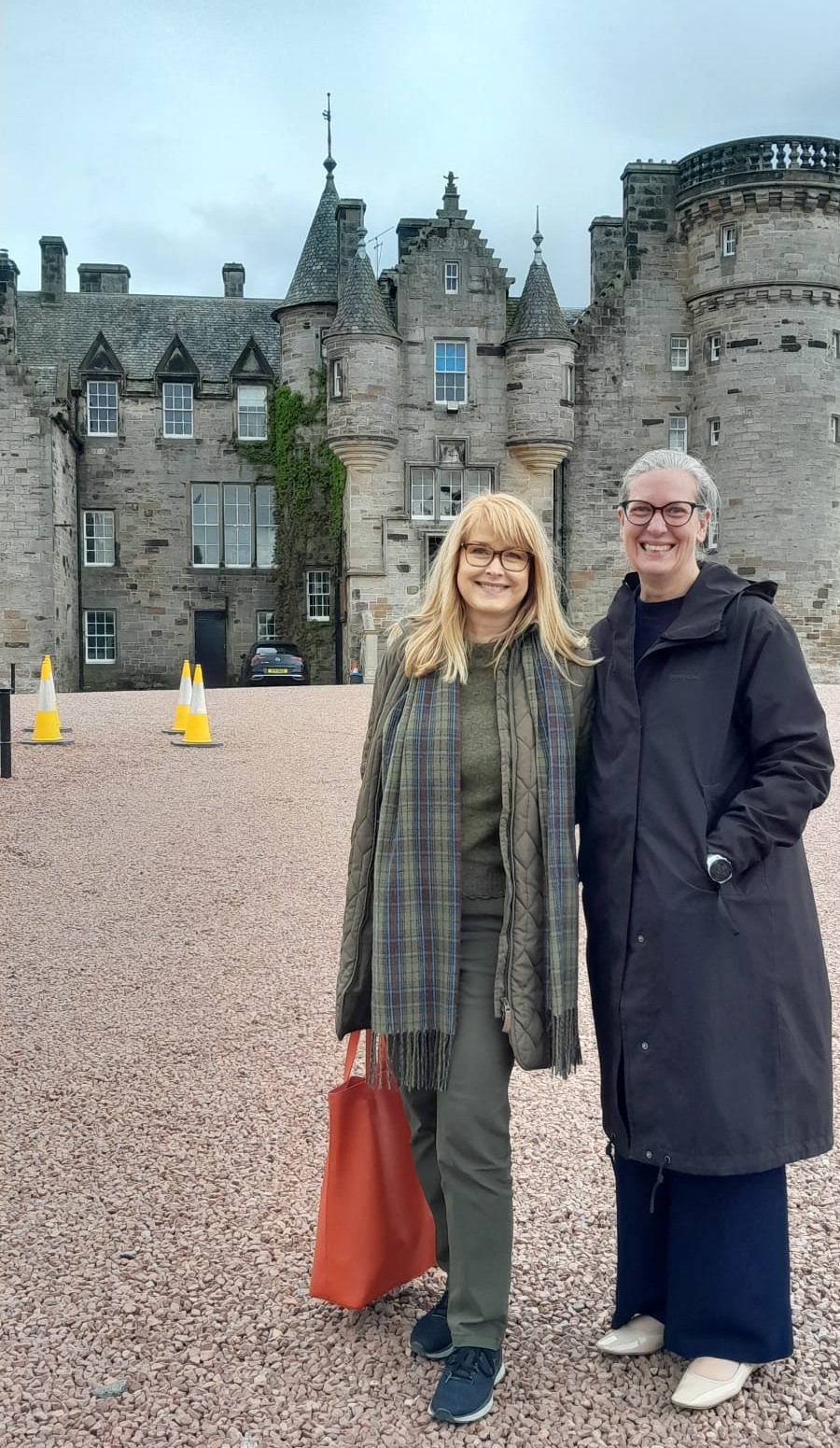
International collaboration and professional exchange continue to be an important part of the work of EFPTA as Clifton Hall School, Edinburgh, and Bootham School, York, were delighted recently to welcome Mette Eggertsen and Malene Vaz from Denmark as part of an ERASMUS-funded visit exploring differences and similarities between the Scottish, English and Danish education systems.
Mette, who teaches Psychology and English, connected via EFPTA with Clifton Hall teacher Mairi Rice, helping to make this professional exchange possible. Her colleague Malene teaches Spanish and English, and together they spent time learning more about teaching and school life in Scotland. A similar connection was made with psychology teacher Harriet Ennis in York.
During their visit to Clifton Hall, the Danish colleagues toured the school, observed the learning environment, and spoke with staff from a range of subject areas.
As part of their wider visit, the group also had the opportunity to meet Harriet Ennis, EFPTA representative for England and Wales. They visited her at Bootham School, gaining valuable insights into another UK school context. This visit further enriched the exchange, offering additional perspectives on teaching practice and strengthening professional connections across EFPTA’s network.
One particularly interesting area of discussion was the contrast in classroom organisation between the two countries. Mette and Malene were fascinated by the Scottish and English systems in which teachers have their own classrooms that can be personalised with displays and resources. In Denmark, students typically remain in the same classroom while teachers move between rooms.
The visit also provided an excellent opportunity to compare approaches to assessment and learning. Discussions highlighted significant differences between Scottish, English and Danish assessment systems, with Danish assessments often being far more discussion-based and verbal in style, similar in some ways to a viva examination, compared with the more written assessment approach commonly used in Scotland and England.
The visit was a valuable opportunity for professional dialogue, cultural exchange, and the sharing of educational ideas and experiences. Experiences such as these demonstrate the strength of EFPTA’s international network and the importance of building connections amongst educators across Europe.